
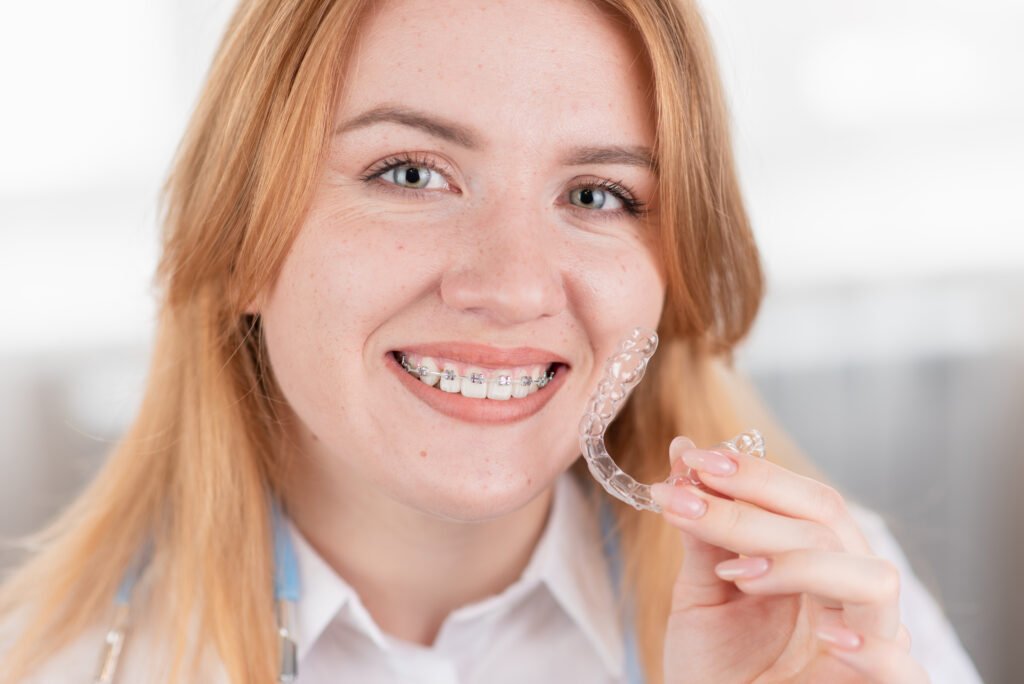
The first question patients often ask when deciding on orthodontic treatment is: metal braces or clear aligners, which is better? The truth is, there's no absolute superiority between the two; the right choice depends on the condition of your teeth, your daily routine, and your expectations from the treatment. Below, we compare the two methods in terms of aesthetics, comfort, hygiene, scope of treatment, and discipline, clarifying which one is better in each situation.
How do metal brackets and clear aligners work?
Metal brackets work with small metal pieces bonded to the surface of each tooth and a wire system connecting them. The wire applies a constant and controlled force to the teeth, moving them into their intended position. The system is fixed in the mouth; that is, it remains in place throughout the treatment and is only adjusted by the dentist.
Clear aligners consist of a series of transparent, removable aligners custom-made to fit your mouth. Each aligner moves your teeth slightly further than the previous one; the series continues by switching to the next aligner at specific intervals. The aligners are almost invisible from the outside and can be removed during meals and brushing.
Aesthetics and comfort: visibility makes all the difference.
Aesthetics are the primary reason why many adult patients opt for aligners. Because clear aligners are colorless and thin, they are difficult to see in social and professional settings. This provides a significant advantage for patients who give presentations, appear on camera, or simply don't want their treatment to be noticeable.
Metal brackets are visible from the outside. For those who don't mind this visibility, especially children and young patients, brackets remain a very common and reliable option. In terms of comfort, the smooth surface of the aligners causes less irritation to the cheeks and the inside of the lips. With metal brackets, a temporary stinging or sensitivity may occur in the first few days of treatment and after wire adjustments; this is usually managed with wax and quick adjustment.
Hygiene and daily care
From an oral hygiene perspective, clear aligners offer a practical advantage: because the aligners are removable, teeth can be brushed and flossed as usual. This makes it easier to protect gum health and reduces the risk of scarring or staining on the teeth after treatment.
With metal brackets, food particles can accumulate around the wire and bracket, requiring more meticulous cleaning. This is entirely manageable with interdental brushes and proper brushing technique; however, if hygiene is not adequately maintained, white spots or gum problems may appear around the brackets. In short, plaque requires easy cleaning; brackets make cleaning a little more challenging.
- Clear aligners: after meals, the teeth and aligners are cleaned and then put back on.
- Metal bracket: The bracket perimeter is protected with an interface brush and regular checks.
- In both methods, regular dental check-ups are essential for the success of the treatment.
Scope of treatment: which treatment is suitable for which case?
This is the crucial point. Clear aligners are very successful in cases of mild to moderate crowding, interdental spaces, and many bite problems. However, in cases of severely rotated teeth, significant jaw misalignment, and complex root movements, they may be insufficient on their own or prolong the treatment.
Metal brackets are effective in a wide range of cases due to the variety and control of the force they apply; they remain one of the most reliable methods, especially in complex and advanced orthodontic corrections. Therefore, the answer to the question of "which is better" often becomes clear after an examination. In some patients, both methods are suitable, and the choice is entirely a matter of personal preference; in others, the condition of the teeth clearly indicates a direction.
Time, discipline, and extractability.
Treatment duration varies in both methods depending on the complexity of the case; in similar cases, the durations may be similar. However, there is an important condition with clear aligners: the aligners must be worn for approximately 20-22 hours a day. Since the aligners are removable, the success of the treatment largely depends on the patient's discipline. In a patient who does not wear the aligners regularly, the treatment will be prolonged or the desired result will not be achieved.
Metal brackets are more “forgiving” in this respect; because the system is fixed, it continues to work 24 hours a day and is not dependent on the patient’s daily decisions. In this sense, brackets are often a safer choice for patients and children who may have difficulty establishing treatment discipline on their own.
Removability is both an advantage and a responsibility of aligners. Being able to remove the aligner for an important meeting, a special occasion, or a meal provides convenience; however, this flexibility also requires the discipline of putting it back on in time. There is no such responsibility with metal brackets, but some dietary restrictions must be followed: very hard and sticky foods can damage the brackets.
So which one is right for you?
In summary, the choice between metal brackets and clear aligners depends not on a single criterion, but on the condition of your teeth, your aesthetic expectations, your daily routine, and how well you can adhere to the treatment discipline. For a patient who prioritizes aesthetics and ease of care and is disciplined in wearing the aligners regularly, clear aligners are often ideal. Metal brackets are preferable if there is a complex orthodontic problem or if the treatment progresses independently of the patient's daily decisions.
The correct decision can only be clarified through clinical examination and measurements. For our patients considering orthodontic treatment in and around Kemerburgaz, Göktürk, Sarıyer, Arnavutköy, Bahçeköy, and Zekeriyaköy, the most appropriate approach is to create the most suitable plan for you by discussing both methods together after an examination that evaluates your teeth and jaw structure.
Frequently Asked Questions
Does a clear plate yield results slower than a metal bracket?
Not necessarily. In similar cases, the durations may be similar; with clear aligners, the determining factor is that the aligners are worn regularly for 20-22 hours a day. In complex cases, metal brackets may provide shorter and more predictable results.
Can clear aligners be used for every dental misalignment?
No. They are very successful in mild to moderate crowding and spacing; however, metal brackets may be more suitable for severely rotated teeth and significant jaw discrepancies. Suitability is determined by examination.
What should I pay attention to regarding my diet while wearing metal braces?
Avoid very hard, crunchy, and sticky foods, as these can damage brackets and wires. Additionally, regularly cleaning the area around the brackets with an interdental brush is important for gum health.
Which one is more suitable for adults?
Adults with aesthetic concerns often prefer clear aligners. However, even in adults, metal braces may be more effective if the case is complex; the best choice will be determined through individual assessment.
To determine which method is suitable for you Kemerburgaz and its surroundings We can evaluate you at our clinic. Smile Design You can get information about it or You can contact us to schedule an appointment..