
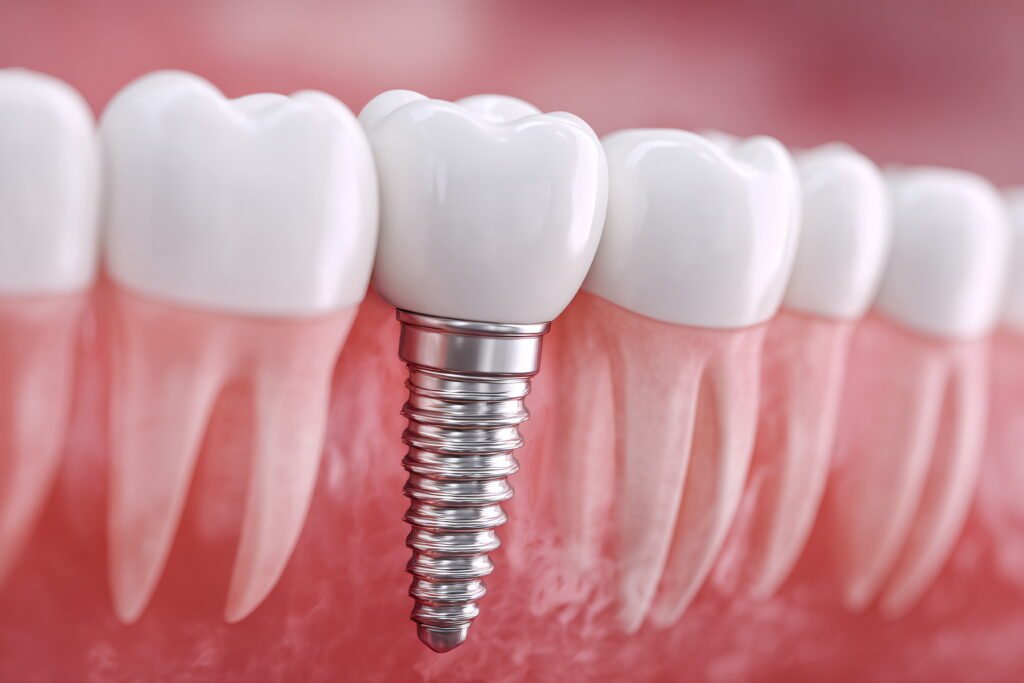
The most common question we hear after a tooth extraction is: "Can we get an implant immediately?" There's no single answer. When an implant is placed after extraction depends on the amount of bone, the health of the surrounding tissue, the presence of infection, and the position of the extracted tooth in the mouth. In some patients, the implant can be placed in the same session as the extraction, while in others, waiting a few months for the socket to heal yields a better result. In this article, we explain the three main timing options, which one is preferred in which situation, and how the decision is made from a clinical perspective.
What happens while the extraction site heals?
When a tooth is extracted, a space called a "socket" remains. In the first few days, a blood clot fills the socket; in the following weeks, soft tissue covers the space, and the underlying bone gradually reshapes itself. Most of the bone is covered by soft tissue in the first 4-8 weeks, but hard bone maturation takes months.
Why is this process important? Because implants are based on the principle of a screw fusing to the bone (osseointegration), and the initial stability of the implant directly depends on the quality and quantity of the surrounding bone. After extraction, the jawbone naturally resorbs somewhat; the thin bone wall, especially on the front surface of the tooth, thins rapidly. The timing of implant placement is precisely about balancing these two facts: we want to place the implant without losing enough bone, but we also want to work on a solid, infection-free foundation.
Immediate implant: In the same session as the extraction.
Immediate implantation involves placing the implant in the same space as the tooth extraction procedure. In the right patient, it's a very comfortable option; it reduces the number of surgeries and shortens the total treatment time. However, it's not suitable for every tooth.
Immediate implantation is generally considered under the following conditions:
- There is no active inflammation or abscess in the extraction site.
- The bone walls surrounding the socket, especially the anterior wall, are strong and of sufficient thickness.
- There is sufficient bone volume for the implant to establish its initial stability by attaching to healthy bone beyond the extraction site.
- There is no contraction or loss of soft tissue.
For single teeth in the anterior region, immediate implant placement can offer an aesthetic advantage because it helps preserve tissue architecture. However, when an implant is placed in the cavity, a gap often remains between the implant and the bone wall; this gap is usually reinforced with a graft (bone powder). The biggest risk of immediate implant placement is that if the bone or tissue is weaker than expected, the implant may not sit in the desired direction and with the necessary stability. Therefore, the decision can only be made after a detailed imaging study before extraction.
Early implantation: 4-8 week waiting period.
Early placement refers to waiting approximately 4-8 weeks after extraction before placing the implant. This time is sufficient for the soft tissue to close the socket and for any mild infection to completely resolve; however, significant volume loss is avoided because the bone is not yet fully mature.
Early placement is particularly preferred in the following situations: the extracted tooth had chronic inflammation or cysts before extraction, requiring a short period for tissue cleaning and healing; or the anterior bone wall was immediately borderline for the implant, and a few weeks of healing made the tissue more predictable. In practice, early placement is a balanced middle ground for many patients who "cannot be as quick as an implant but also don't need to wait months." At this stage, the spaces between the implant and the bone are often supported with a graft.
Delayed implantation: 3-6 month waiting period and when it's needed.
In delayed implantation, the extraction socket is allowed to fully fill and mature with bone; this usually takes 3-6 months. Although it may seem like a longer process, in some cases this is the safest approach.
We recommend late placement in the following situations:
- There was a significant infection, abscess, or inflamed tissue in the extraction site; complete bone healing is crucial for the longevity of the implant.
- A significant portion of the bone walls was lost during the extraction, and bone volume needs to be restored first.
- In posterior molars, bone recovery is expected in large, multi-rooted sockets.
- If the patient's overall health condition or factors affecting recovery do not make hasty surgery appropriate.
The known disadvantage of delayed placement is that some jawbone naturally resorbs during the waiting period. To minimize this, socket preservation is performed at the time of extraction.
Socket preservation (graft) and bone preservation
Socket preservation involves placing a bone graft into the socket that becomes available after tooth extraction, and usually covering it with a membrane. The goal is to slow bone resorption during the waiting period and leave a fuller, more predictable base for an implant in the future.
Socket preservation is particularly valuable for teeth where delayed placement is planned, where there is bone loss in the extraction area, or in aesthetically sensitive areas. Even though this procedure separates the extraction from the implant by months, it ultimately ensures stronger bone around the implant, supporting long-term success. Grafting is not necessary for every extraction; the decision is determined by the expected bone behavior after extraction and the priority of that particular area for implant placement.
We will make the decision with CBCT.
The right timing for you cannot be guessed by looking at the mouth; it is determined by measurement. Our clinic's 3D digital tomography (CBCT) scan examines the jawbone in three dimensions, clearly showing the bone's height, thickness, and density, the integrity of the extraction socket walls, and anatomical relationships such as the sinus cavity and nerve canal.
This imaging allows us to objectively assess whether the implant is safe, whether a graft is needed, and how long to wait for a better outcome. For patients coming to our clinic in Kemerburgaz from Göktürk, Sarıyer, Arnavutköy, Bahçeköy, and Zekeriyaköy, we first perform this three-dimensional assessment and then create a personalized timing plan for each patient. In short, there is no single answer to the question "when is an implant placed after bone extraction?"; the correct answer is shaped by the story your bone and tissue tell.
Frequently Asked Questions
Can I get an implant immediately after a tooth extraction?
If there is no infection in the extraction site and the bone walls are sufficiently strong, the implant can often be placed in the same session. This can only be confirmed after evaluating the bone with CBCT.
How long do I need to wait after the photoshoot?
It depends on the situation: immediately (in the same session), early (4-8 weeks), or late (3-6 months). If there is infection or bone loss, a longer wait yields a healthier result.
What happens if the bone atrophies during the waiting period?
After extraction, some jawbone naturally resorbs. To minimize this, socket preservation (grafting) can be applied at the time of extraction; this leaves a fuller base for future implants.
How do you make the timing decision?
We make this decision by measuring bone volume, tissue health, and anatomical relationships using 3D digital tomography (CBCT). Based on this assessment, we create a personalized treatment plan for each patient.
To schedule your implant placement after the extraction. Göktürk and its surroundings We can evaluate you at our clinic. Dental implant treatment You can get information about it or You can contact us to schedule an appointment..