
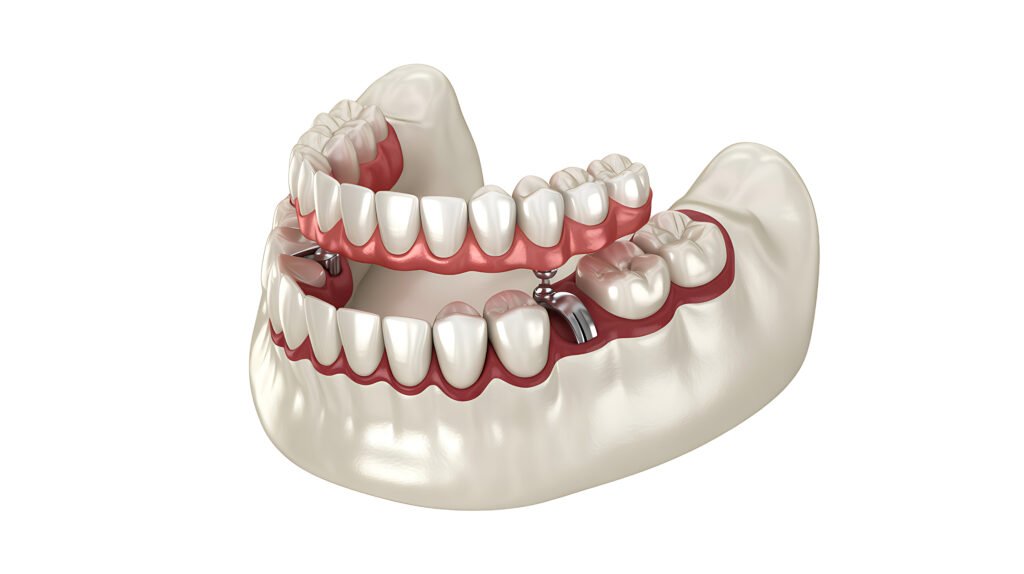
Implants replace the tooth root; however, the prosthesis placed on top is the actual part you will feel in your mouth all day long. Even with the same number of implants, very different solutions can be achieved: some patients need a single screw-retained crown, while others need a removable prosthesis that supports the entire jaw. This choice directly determines your chewing power, speech, hygiene habits, and the condition of your gums ten years from now. At our clinic in Kemerburgaz, we use 3D digital tomography (CBCT) to visualize bone volume and implant angle on the same day, and plan the type of prosthesis from the outset; because the right prosthesis decision is made before implant placement.
Implant-supported fixed prostheses: crowns and bridges.
Fixed prostheses are screwed or cemented to the implant and cannot be removed by the patient. They offer the closest feeling to your own teeth in daily life; your biting force is largely returned, and a foreign surface like gingival plaque doesn't cover your mouth.
Fixed solutions are basically established in two scenarios:
- Missing single tooth: A single crown on a single implant. Adjacent healthy teeth are not cut; it stands on its own. In terms of aesthetics, gum level and eruption profile are the most critical details.
- Missing a few teeth: A fixed bridge placed between two or more implants. For example, three gaps between teeth in the back can be closed with a bridge supported by two implants; it is not always necessary to place separate implants in each gap.
Today, our preference for fixed prostheses is mostly screw-retained attachment. Its advantage over cementation is that the prosthesis can be removed, cleaned, and inspected when necessary, and the risk of cement leaking into the gums and causing inflammation is eliminated. Zirconium and monolithic ceramics stand out as materials for both durability and natural light transmission. We plan the material selection individually for each patient, prioritizing durability in the posterior region where chewing forces are high, and aesthetics in the anterior region.
The most common misconception about fixed prostheses is the idea that you need "as many teeth as there are implants." However, in a bridge, two strong implants can support the gap between them with the bridge body; the goal is not to place implants in every gap, but to place the correct number of implants at the right angle to safely distribute the force. This both simplifies the surgery and protects the bone area from unnecessary stress.
Fixed solution for full jaw: All-on-4 and All-on-6
Even in a patient who has lost all their teeth, a fixed prosthesis is possible. The logic here is to distribute the entire jaw onto 4 to 6 implants at strategic angles. By placing the posterior implants at an angle, the sinus and nerve areas are safely bypassed, so that in most patients a fixed bridge can be screwed in without the need for additional bone augmentation surgery.
For this group, CBCT is essential. Planning the implant angle without a three-dimensional view of bone density, sinus floor, and the course of the nerve canal in the mandibular joint means proceeding blindly. Since we perform the CT scan on the same day at our clinic, the patient learns concretely during the first consultation whether their own bone can support a fixed prosthesis.
The price of a fixed full jaw prosthesis is that it requires a little more meticulous cleaning: the transition area between the prosthesis and the gum must be regularly cleaned with interdental brushes and a water jet. In return, the patient lives with an open palate and a jaw that is almost like their own teeth, without the hassle of removing and reinserting it.
Implant-supported removable prosthesis: overdenture
Removable dentures are attached to implants but can be removed and reinserted by the patient. Unlike classic full dentures, they are no longer fixed to the palate or reliant on adhesive; instead, they are anchored to implants, remaining in place while speaking and chewing. This is called implant-supported overdenture.
We use two basic clamping systems:
- Locator (individual button) holder: Typically, a retaining cap is placed on each of the 2-4 implants, and a corresponding cap is placed inside the prosthesis. When the prosthesis is pressed into place, it locks with a click. Cleaning and maintenance are relatively simple, and retaining parts are easily replaced when they wear out.
- With bar holder: The implants are connected to each other by a metal bar, and the prosthesis sits on this bar. Because it distributes the load more evenly between the implants and provides a more stable hold, it is preferred, especially in patients with limited bone support in the lower jaw.
Our choice of overdenture is not random. In patients with advanced bone and soft tissue loss, where lip support needs to be re-established with the pink acrylic part of the prosthesis, a removable prosthesis can provide a more natural facial profile than a fixed bridge. Furthermore, because it offers a complete jawline solution with fewer implants, it reduces surgical burden and overall cost. However, in patients with limited dexterity who may have difficulty removing and cleaning the prosthesis, this advantage can become a disadvantage; therefore, the decision is made based on the patient's daily life.
Comfort and cleanliness: the real difference between the two options.
The choice between fixed and removable prostheses is often not a matter of "which is better," but rather "which is right for you." Let's clarify the difference under two headings.
Chewing and feeling: Fixed prostheses provide the closest possible biting force and sensation to natural teeth; taste and speech are more natural because the palate remains open. While overdentures offer significantly superior chewing power compared to classic prostheses, they fall short of fixed solutions; however, their ability to move in and out of the mouth, and their capacity to fully restore the jaw even in very limited bone, are significant advantages.
Cleaning: Here, the relationship is reversed. Fixed dentures are comfortable, but their cleaning requires discipline inside the mouth with an interdental brush and water jet; neglecting this increases the risk of peri-implantitis (inflammation around the implant). Removable dentures, on the other hand, are relatively easy to clean because they can be removed and thoroughly cleaned with a brush, but they require the habit of putting them in and taking them out every day.
In practice, the factors that determine the decision are: the amount of bone and gum tissue remaining, the number and location of missing teeth, your bite force, your aesthetic expectations, your dexterity, and the scope of the surgery within your budget. None of these variables can be honestly answered without an examination.
Choosing the right prosthesis: personalized planning.
The same "missing teeth" condition can be resolved with two different prostheses in two different patients. A single implant-supported crown might suffice for a young person with healthy bone and only one missing tooth; however, a bar-retained overdenture might yield a much more viable result for a patient who has been edentulous for years and has experienced bone loss. Therefore, we discuss the type of prosthesis before considering the number of implants.
At our Kemerburgaz clinic, the process begins with creating a three-dimensional map of your bone using CBCT on the same day. After seeing your bone volume, sinus and nerve proximity, and gum level, we can clearly discuss whether a fixed or removable solution is most suitable for your mouth. For our patients coming from surrounding areas, primarily Göktürk, Sarıyer, Arnavutköy, Bahçeköy, and Zekeriyaköy, our goal is not to use a trendy technique, but to create a prosthesis that you will be able to use comfortably even ten years from now. Regardless of the severity of your missing teeth, an examination appointment to evaluate the options together is the first and most appropriate step.
Frequently Asked Questions
Which is better: a fixed prosthesis or a removable prosthesis supported by implants?
There is no single "better" answer; it depends on the amount of bone remaining, the number of missing teeth, aesthetic expectations, and your cleaning habits. While fixed prostheses offer the closest comfort to natural teeth, removable overdentures can fully restore the jaw in cases of limited bone.
Is a fixed prosthesis possible in cases of complete edentulism (loss of the entire jaw)?
Yes. With the All-on-4 or All-on-6 approach, the entire jaw can be supported by a fixed bridge screwed onto 4-6 implants placed at an angle. Suitability is determined by evaluating your bone density and sinus-nerve proximity with CBCT.
Can implant-supported overdentures be removed and reinserted?
Yes, a removable overdenture can be taken out and put back in by the patient; however, unlike a classic prosthesis, it is anchored to implants with locators or bar retainers, so it doesn't slip while speaking or chewing. Its removable nature also makes cleaning easier.
When is the type of prosthesis decided upon?
The decision regarding the prosthesis is made before implant placement. At our clinic, a 3D CT scan is taken the same day to visualize your bone condition; the number and angle of implants are planned according to the desired prosthesis type.
To determine the most suitable implant-supported prosthesis for you. Kemerburgaz and its surroundings We can evaluate you at our clinic. Dental implant treatment You can get information about it or You can contact us to schedule an appointment..