
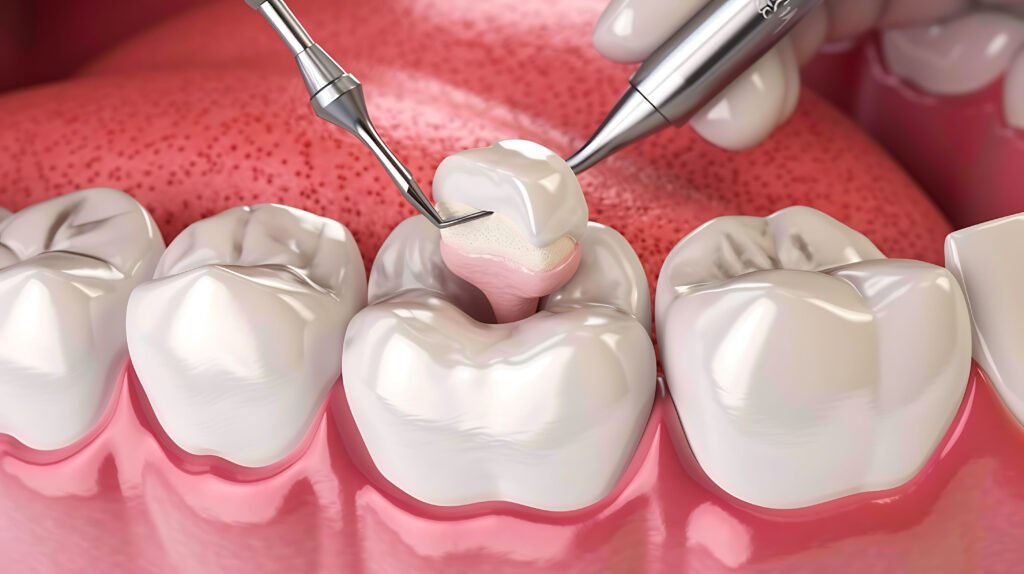
If, after removing a large cavity, very little healthy tissue remains in the tooth, a classic filling may not always be a safe solution. This is where inlay and onlay fillings come in: unlike fillings shaped in the mouth in a single step, they are durable restorations custom-made for the tooth in a laboratory or using digital systems. At our clinic in Kemerburgaz, we consider this treatment to be the most durable of the intermediate solutions between fillings and porcelain veneers.
What are Inlay and Onlay Fillings?
Inlays and onlays are essentially pre-prepared restorations that replace the tissue the tooth has lost. In a classic composite filling, the dentist cleans the decay, then places the filling material into the cavity and hardens it with light in the mouth. In inlays and onlays, a different approach is taken: an impression of the tooth is taken, and a porcelain or composite piece is produced in a laboratory or using CAD/CAM devices based on this impression, and then bonded to the tooth.
The difference between the two lies in the area they cover. An inlay fills the space between the ridges (prominences) on the chewing surface of the tooth; that is, it is preferred if the tooth structure loss is in the center of the tooth. An onlay, on the other hand, covers a wider area, including one or more ridges. In this respect, an onlay can be thought of as a bridge between a filling and a crown: it does not cover the entire tooth as much as a crown, but it reconstructs a much larger area that a filling cannot reach.
What is the difference from classic fillers?
The most fundamental difference lies in the manufacturing method. Composite fillings are shaped directly on the tooth, under oral conditions. Inlays and onlays, on the other hand, are produced outside the tooth, in a controlled environment. This detail directly affects the durability and fit of the restoration to the tooth.
Large composite fillings placed inside the mouth can carry a risk of shrinkage, marginal leakage, and fracture over time. The larger the filling, the greater these risks. Inlays and onlays produced in a laboratory or digitally are not affected by polymerization shrinkage and offer a more resistant structure to chewing forces. In addition, since the contact points of the tooth with adjacent and opposing teeth can be adjusted more precisely on the impression, a more harmonious result is obtained in terms of bite balance and gum health.
Another difference concerns material preservation. During veneer application, the tooth is ground down circumferentially. With inlays/onlays, only the decayed and weak tissue is removed; a large portion of the healthy tooth tissue is preserved. Therefore, inlays/onlays are a tissue-friendly approach that repairs significant tooth loss "without cutting more teeth than necessary.".
When and for whom is it preferred?
Inlay-onlay fillings are not necessary for every tooth. For small to medium-sized cavities, classic composite fillings are a sufficient and practical solution. However, in some cases, inlay-onlays stand out significantly:
- In cases of significant material loss where the decay or old filling is very extensive and sufficient durability cannot be achieved with conventional fillings.
- In areas with heavy chewing load, such as molars and premolars
- In cases where one or two ridges are fractured, but the tooth is not weakened enough to require a crown.
- When old, large, deteriorated fillings need to be renewed
- When additional support is requested for teeth that have undergone root canal treatment but do not yet require a full crown
The suitability decision is made based on the amount of healthy tissue remaining in the tooth, the chewing forces, and the position of the tooth in the mouth. In patients with good gum health and good oral hygiene, inlay-onlay restorations can provide problem-free service for many years. In patients with bruxism, or teeth grinding, material selection and additional measures such as night guards are evaluated separately.
Treatment Process: Two Sessions or Same Day?
Inlay-onlay treatment can be completed using two different methods. In the classic method, the procedure is usually performed in two sessions. In the first session, the decay is cleaned, the tooth is prepared for restoration, and an impression is taken; this impression is sent to the laboratory. A temporary filling is placed in the tooth until the restoration is ready. In the second session, the manufactured inlay-onlay is tried on, its fit is checked, and it is fixed to the tooth with special adhesives.
With the widespread adoption of digital dentistry, CAD/CAM systems allow this process to be completed on the same day in most cases. In this method, the tooth's impression is taken digitally using an intraoral scanner, the restoration is designed in a computer environment, and then manufactured from a porcelain block using a milling machine within the clinic. This largely eliminates the need for temporary fillings and second appointments. Which method will be applied is determined according to the condition of the tooth and the clinic's capabilities.
In both methods, the bonding stage is critically important. The perfect bonding of the inlay/onlay to the tooth with adhesive systems ensures the longevity of the restoration and minimizes the risk of marginal leakage. Therefore, the procedure requires meticulous work with good isolation.
Advantages and Maintenance
The most significant advantage of inlay-onlay restorations is their durability and fit. Thanks to laboratory or digital manufacturing, a structure that fits the tooth perfectly and distributes chewing forces effectively is obtained. Porcelain materials offer an aesthetic very close to the natural tooth color; they are more resistant to discoloration and wear than traditional fillings. Furthermore, preserving a large portion of the tooth tissue is a significant benefit for the long-term health of the tooth.
In terms of care, inlays and onlays do not require different attention than natural teeth. Brushing twice daily, interdental cleaning, and regular check-ups with the dentist will extend the life of the restoration. Keeping the edges where the restoration joins the tooth clean is especially important to prevent the recurrence of decay. For our patients coming from Kemerburgaz, Göktürk, Sarıyer, Arnavutköy, Bahçeköy, and Zekeriyaköy areas, we recommend regular check-ups every six months to regularly evaluate the restorations.
In conclusion, inlay-onlay fillings are an effective way to repair teeth with significant substance loss in a tissue-friendly and durable manner, without the need for crowns. If you suspect you have a large cavity or fracture in your tooth, it's best to determine which type of restoration is right for you only after an examination.
Frequently Asked Questions
How durable are inlay/onlay fillings?
With proper oral hygiene and regular check-ups, inlay and onlay restorations can be used without problems for many years; thanks to their laboratory-fabricated structure, they are more resistant to chewing forces than large composite fillings.
Is getting inlays/onlays a painful procedure?
The procedure is performed under local anesthesia, so no pain is felt; the caries removal and impression taking stages are completed comfortably, although there may be some mild sensitivity for a short time afterwards.
Which is better: inlay/onlay or veneer?
This depends entirely on the amount of healthy tissue remaining in the tooth; if the tooth hasn't weakened enough to require a crown, inlays or onlays, which require less tissue removal, are generally preferred.
Can inlays and onlays be completed in a single session?
With CAD/CAM digital systems, the process can often be completed in the same day; however, with traditional laboratory methods, the process is usually finished in two sessions.
To discuss the most suitable restoration for your tooth with substance loss. Kemerburgaz and its surroundings We can evaluate you at our clinic. Root Canal Treatment You can get information about it or You can contact us to schedule an appointment..