
Almost everyone who has lost one or more teeth comes up with the same question: dentures or implants? In reality, these two treatments are not competitors, but rather two distinct approaches addressing different needs. The right choice depends on the individual's jawbone condition, overall health, expectations, and budget. In this article, we compare the two methods clinically, without exaggeration, and explain why the decision should be personalized.
What are implants, and what are prosthetics?
A dental implant consists of a titanium screw placed in the jawbone and a porcelain tooth fixed onto this screw. Because it replaces the root of a lost tooth, it is considered the closest option to a natural-looking tooth.
A prosthesis is a solution that fills in missing teeth by providing support or resting on the gums. It can be removable or fixed. There are different types, such as full dentures, partial dentures, and bridges. The fact that it doesn't require surgery and can be completed in a shorter time are its prominent features.
Bone preservation: the most significant advantage of the implant.
After tooth loss, the jawbone in that area begins to resorb over time; this is called bone resorption. Because implants transmit chewing forces to the bone just like a natural root, they largely stop this resorption and keep the bone alive. This is important not only for aesthetics but also for preserving facial features in the long term.
In classic removable dentures, the force is transmitted as pressure on the gum and the underlying bone. This can accelerate bone loss over time; the prosthesis may loosen and need to be replaced or refilled periodically. If bone preservation is your priority, implants stand out in this respect.
Comparison of comfort, chewing performance, and aesthetics.
Fixed implant-supported teeth feel like your own teeth in the mouth; because they are not covered by gingival plaque, taste, speech, and chewing are quite natural in most patients. The biting force is close to that of natural teeth, which allows for comfortable consumption of hard foods.
Removable dentures may require an adjustment period. Especially with upper full dentures, taste and speech may change initially because the palate is covered; lower dentures may occasionally shift due to the movement of the tongue and jaw muscles. However, dentures today also provide aesthetically pleasing results and, when properly planned, appear to harmonize with the smile.
- Stability: Implants are fixed; classic prostheses are removable, and hybrid solutions fall somewhere in between.
- Chewing strength: Implants closely resemble natural teeth; this is somewhat more limited with removable prostheses.
- Care: The prosthesis needs to be removed and cleaned daily; the implant is brushed just like your own teeth.
- Processing time: The prosthesis is completed in a shorter time; bone healing is allowed for the implant.
How do bone condition and overall health affect decisions?
The success of implant treatment largely depends on the jawbone having sufficient height and thickness. In patients with long-standing tooth loss, bone resorption may occur. In this case, implants are still possible, but additional procedures such as bone grafting or sinus lifting may be required. Whether there is truly sufficient bone cannot always be determined by clinical examination alone; this is where three-dimensional imaging comes into play.
Overall health is also a determining factor. Uncontrolled diabetes, heavy smoking, certain bone diseases, or the use of specific medications can affect implant healing. In such cases, a non-surgical prosthesis may be a more suitable and safer option. Age alone is not a barrier; overall health and bone quality are the determining factors.
Hybrid solution: implant-supported prosthesis
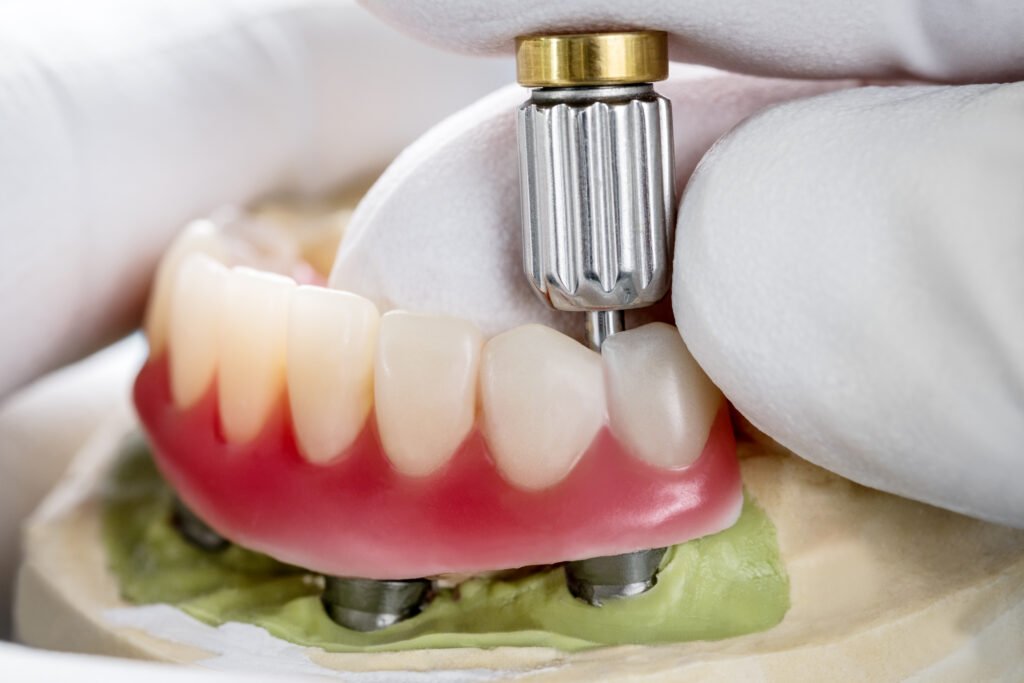
There is also an option that combines the advantages of both methods: implant-supported (implant-supported) prostheses. Here, several implants placed in the jawbone ensure the prosthesis is firmly anchored. This prevents the prosthesis from moving, significantly improves chewing comfort, and results in less surgery and generally a more affordable plan compared to placing implants for each individual tooth.
This solution can be a good middle ground, especially for patients who have lost many teeth, whose bone is not entirely suitable for implants, or who want a more economical but stable result. The prosthesis can be designed to be fixed or removable for cleaning.
Three-dimensional tomography clarifies the correct decision.
There is no single right answer to the question of whether to choose a prosthesis or an implant; the answer varies from person to person. Key details such as bone height, bone quality, and the location of the sinus cavities and nerve canal can only be clearly seen with a three-dimensional assessment. Our clinic's 3D CT scanner examines the jawbone with millimeter precision, determining in advance whether an implant is suitable and whether additional procedures are necessary.
This ensures that treatment is based on measurable data, not guesswork. During the examination, your expectations, general health status, and CT scan findings are evaluated together to determine the most suitable option for you. Our approach is the same for patients coming from Kemerburgaz, Göktürk, Sarıyer, Arnavutköy, Bahçeköy, and Zekeriyaköy: first, an accurate diagnosis, then a personalized plan. A detailed examination and imaging are always the first step in creating a clear roadmap for your missing tooth.
Frequently Asked Questions
Prosthetics or implants, which is better?
There is no single superior method; implants preserve bone and remain stable, while prostheses are non-surgical and more economical. The right choice depends on your bone condition, overall health, and expectations.
Is the implant suitable for every patient?
It is generally feasible, but requires sufficient jawbone and good overall health. If bone is missing, it may be possible with additional procedures; suitability is clarified with 3D tomography.
How comfortable is chewing when using dentures?
Removable dentures may require initial adjustment, and chewing power is somewhat limited compared to natural teeth. Implant-supported dentures, however, significantly increase comfort.
What examination is required for a decision?
In addition to clinical examination, bone height and quality are assessed using three-dimensional tomography (CBCT). These findings, along with your expectations, will be considered to create a personalized treatment plan.
To clarify whether you should get an implant or a prosthesis for your missing tooth. Göktürk and its surroundings We can evaluate you at our clinic. Dental implant treatment You can get information about it or You can contact us to schedule an appointment..