
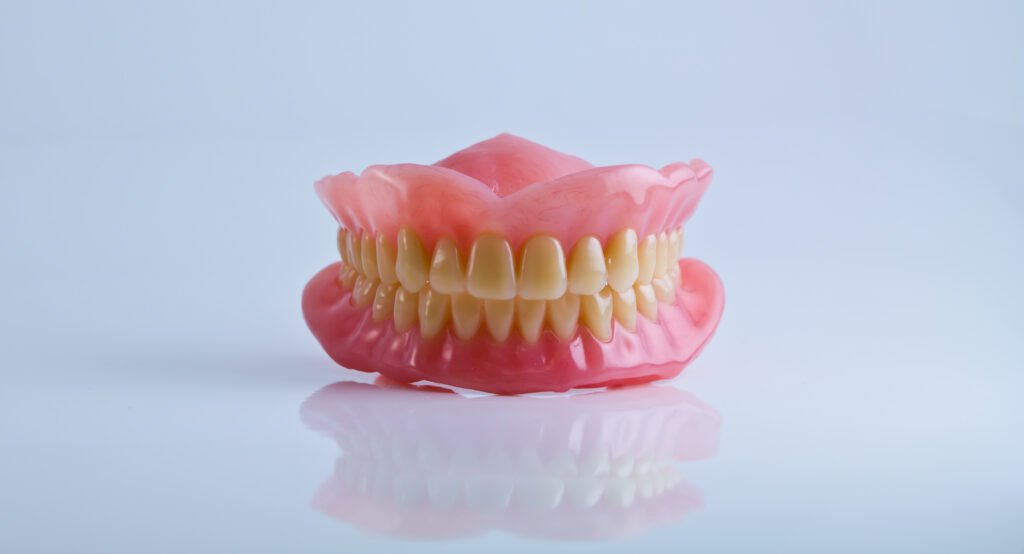
When no natural teeth remain in the mouth, or when all remaining teeth must be extracted, the most common way to restore chewing, speaking, and aesthetic functions is with a full denture. Often referred to as a "palate" or "denture," this removable prosthesis sits on the jawbone and gums, replacing all missing teeth. At our clinic in Kemerburgaz, we plan this treatment weekly for patients who have been edentulous for a long time or have recently undergone extractions. In this article, I explain what a full denture is, who it is suitable for, and what actually happens during the process, based on clinical realities.
What are complete dentures and who are they suitable for?
Complete dentures are a type of removable prosthesis that the patient can put in and take out themselves, used when there are no teeth left in one jaw (upper, lower, or both). They consist of artificial teeth arranged on an acrylic base, and this base, which sits on the gums, functions by taking support from the oral tissues. They are not fixed; that is, they are not screwed into the jawbone, but stay in place by conforming to the shape of the gums and bone.
Complete dentures are generally considered in the following situations:
- Loss of all teeth due to advanced gum disease or decay
- The remaining teeth are beyond saving and require extraction.
- Patients for whom implant treatment is deemed unsuitable due to bone deficiency, general health condition, or personal preference.
- Individuals who have been edentulous for a long time and wish to regain both aesthetic appeal and chewing function.
Age alone is not the determining factor. What matters is the condition of the teeth in the jaw, the quality of the gums, and the underlying bone. In some patients, a full denture is applied in only one jaw, while the other jaw may have natural teeth or a partial denture.
How do complete dentures stay in the mouth?
This is the question that patients are most curious about and most concerned about: "Will this prosthesis stay in place?" The answer lies in understanding how the attachment occurs. Upper and lower jaw prostheses are attached through completely different mechanisms, and knowing this from the start allows for more accurate expectations.
Full upper dentures have a large surface area covering the entire palate. A thin layer of saliva forms between the denture and the gum, creating a suction (vacuum) effect similar to water between two glasses. The larger the palate surface area, the stronger this suction; therefore, upper dentures generally adhere better.
A lower jaw prosthesis presents a different challenge. In the lower jaw, the tongue moves, the attachment surface is much narrower, and the horseshoe-shaped base is surrounded on all sides by mobile tissues. Therefore, the suction effect is weak in lower full dentures; the prosthesis stays in place primarily by resting on the bony ridge and balancing with surrounding muscles. Experiencing an initial feeling of looseness with a lower prosthesis is expected and does not necessarily mean the prosthesis is poorly made.
The most fundamental factor determining retention is the amount of underlying bone. After teeth are extracted, the jawbone gradually resorbs; the longer the period of edentulism (toothlessness), the flatter the surface on which the prosthesis will sit, and the more difficult it becomes for the prosthesis to attach. Therefore, planning the prosthesis after extraction should not be neglected.
Production Stages: What Happens During Appointments?
A complete denture isn't finished in a single session; the prosthesis takes shape step by step over several consecutive appointments. Each stage builds upon the previous one, and rushing the process directly impacts the outcome.
- Initial examination and preliminary measurements: The gums, bone structure, and any previous prostheses are evaluated. An initial impression is taken with a standard tray, and a custom impression tray is prepared for the patient.
- Precise measurement: A detailed impression is taken using a custom-made tray, reflecting the true boundaries of the tissues. This is one of the most critical stages in determining the success of the prosthesis.
- Jaw relationship record: The relative position of the upper and lower jaws, the height of the occlusion, and the midline are determined. This record determines where the teeth will be aligned.
- Test (gear test): Artificial teeth are placed on wax and tried in the mouth. At this stage, the color, size, alignment, and smile aesthetics of the teeth are evaluated together; the prosthesis is not finalized without the patient's approval.
- Delivery: The acrylic-processed prosthesis is placed in the mouth, and the occlusion and pressure points are checked, and necessary adjustments are made.
After delivery, one or more follow-up appointments are usually required within a few days. These appointments address any pressure the prosthesis is putting on the gums, causing sores or irritation; this is a normal and expected part of the process.
Adaptation Process: Speaking and Chewing
Getting used to a new full denture takes time, and it's important to be honest about that. In the first few days, you may experience a feeling of fullness in your mouth, increased salivation, and even a slight gag reflex. These are natural signs of the tissues adapting to a foreign object and usually subside within days.
Speech may be affected initially; temporary differences may occur, especially in sounds such as “s”, “f”, and “t”. During this period, reading aloud or talking on the phone speeds up the coordination of the tongue with the new prosthesis. Most patients notice that their speech returns to normal within a few weeks.
Chewing should be gradual. In the first few days, eating soft, small pieces, distributing the food evenly across the mouth if possible, helps maintain the balance of the prosthesis. It's wise to avoid hard, sticky, and very small foods initially. Chewing capacity increases over time, but knowing from the outset that a full prosthesis only provides a certain percentage of the chewing power of natural teeth helps keep expectations realistic.
Advantages, Limitations, and Implant-Supported Alternatives
The most important advantage of complete dentures is that they restore both aesthetics and function in patients who have lost all their teeth, relatively quickly and without the need for surgery. They are often the most feasible option for patients with bone deficiency or those unsuitable for surgery.
Limitations should also be discussed clearly. A removable prosthesis does not hold as strongly as fixed teeth; movement can occur, especially in the lower jaw. As jawbone continues to resorb over time, the prosthesis may loosen every few years, requiring refilling or replacement. The upper prosthesis, which covers the surface of the palate, may slightly affect taste in some patients.
These limitations, particularly in the lower jaw, reduce quality of life, making implant-supported dentures (overdentures) a valuable alternative. In this method, several implants placed in the jaw provide attachment points for the removable prosthesis. The prosthesis sits on these implants with clips or button-like connections; thus, it becomes much more stable while remaining removable. Overdentures placed on two implants, especially in the lower jaw, make a significant difference in retention and chewing comfort. The suitability of the bone and overall health for implant treatment requires a separate assessment.
Which option is right is determined individually, based on the condition of the jawbone, the patient's expectations, and overall health. At our Kemerburgaz clinic, we first thoroughly evaluate patients coming from the Göktürk, Sarıyer, Arnavutköy, Bahçeköy, and Zekeriyaköy areas, and together we discuss and decide on both classic full dentures and implant-supported options.
Frequently Asked Questions
Can complete dentures cause pain?
In the first few days, there may be some pulsating and sensitive areas where pressure is applied to the gums; as these areas are adjusted during check-up appointments, the discomfort will decrease and eventually disappear.
How long does it take to get used to a full prosthesis?
Although it varies from person to person, speech usually becomes significantly easier within a few weeks, and chewing within a few weeks to a few months; getting used to the lower jaw generally takes longer than getting used to the upper jaw.
Why do lower full dentures move more?
The attachment surface in the lower jaw is narrow, the tongue is mobile, and the suction effect is weak; therefore, movement is to be expected, and implant-supported prostheses significantly reduce this problem.
What is the difference between a complete denture and an implant-supported denture?
While classic complete dentures rely solely on support from the gums and bone, implant-supported dentures are much more stable by attaching to implants placed in the jaw, and particularly improve comfort in the lower jaw.
To discuss the most suitable prosthetic or implant solution for you. Kemerburgaz and its surroundings We can evaluate you at our clinic. Dental implant treatment You can get information about it or You can contact us to schedule an appointment..