
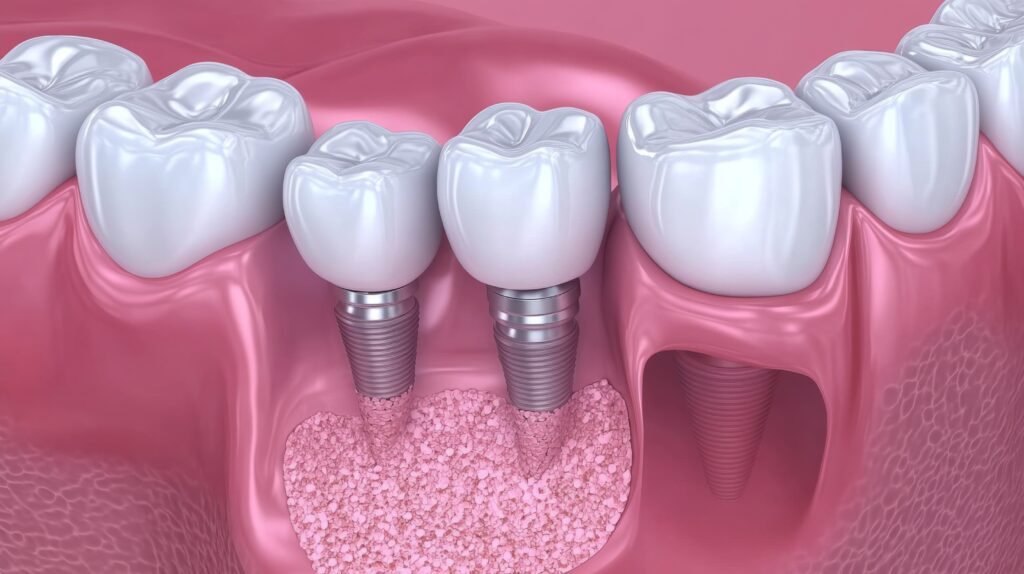
In the treatment of missing teeth, implants are considered one of the closest solutions to natural teeth. However, when a patient sits down with us, the first question is often: "Which is more suitable for me: a zirconium implant or a titanium implant?" These two options have different material histories and different areas of use in dentistry. At our clinic in Kemerburgaz, Göktürk, and Sarıyer, we make this decision together with the patient, taking into account their gum structure, aesthetic expectations, and general health condition. Below, we compare the two implant types as balanced as possible.
Why are titanium implants considered the gold standard?
Titanium is the material that has been used in modern implant dentistry for decades and has undergone the most clinical research. This long history is the main reason why titanium is referred to as the "gold standard." The strong bond it forms with bone tissue, or osseointegration, is well-documented in scientific studies. Long-term follow-up studies show high success rates in properly planned titanium implants.
Another advantage of titanium is its mechanical strength. Chewing forces are particularly high in posterior molars; titanium exhibits reliable performance in terms of flexure and fracture resistance against these loads. Furthermore, titanium implants are often manufactured as two-piece systems. This design allows for adjustment of the angle between the implant body and the superstructure, enabling more flexible prosthesis planning. This flexibility provides a significant advantage in challenging cases and multi-unit bridge solutions.
Titanium is a metal that is quite well tolerated by the body biologically, and true titanium allergy is rare. However, the fact that it contains metal may raise concerns for some patients, both aesthetically and in terms of personal preference. This is where zirconium implants come into play.
Another practical advantage of titanium implants is their wide range of manufacturers and products. With numerous titanium implant options available in different diameters, lengths, and surface treatments, the surgeon can choose the size best suited to each patient's bone volume and the location of the gap. This variety facilitates solutions in different clinical scenarios, from narrow bone areas to wide molar regions. Furthermore, years of accumulated surgical experience and standardized protocols make titanium implant applications predictable for both surgeons and patients.
What are zirconium (ceramic) implants and what are their distinguishing features?
Zirconium implants, technically known as zirconium dioxide-based ceramic implants, are characterized by being metal-free. This is a significant advantage for patients concerned about metal sensitivity or who prefer not to have metal implants in their mouths.
Zirconium has a whitish color, close to the color of natural teeth. This characteristic can be particularly important in individuals with thin and translucent gums. With titanium implants, if the gums thin over time, the grayish shade of the metal body may be reflected as a slight darkening at the gum line. The light color of zirconium reduces this risk and can provide an aesthetic advantage in prominent areas of the smile, such as the front of the mouth.
Another noteworthy point is the report that zirconium surfaces have a relatively low susceptibility to plaque accumulation. Data exists indicating that gingival tissue behaves compatibly with ceramic surfaces. However, the clinical history of zirconium implants is shorter than that of titanium, and long-term follow-up data is not yet as extensive as for titanium. Therefore, it would not be accurate to present zirconium as "superior in every aspect"; rather, it should be considered as a prominent alternative in specific situations.
Differences in durability and design.
One of the most significant technical differences between the two materials is their structural design. Titanium implants are generally two-piece; the body and the abutment to which it is attached are separate parts. A significant portion of zirconia implants, however, are manufactured as a single piece. This one-piece design can reduce the risk of gaps and loosening between the parts; however, it also limits the flexibility for angle correction in prosthesis planning.
In terms of durability, titanium is more tolerant to sudden loads due to its flexibility. Zirconium, on the other hand, is a hard and rigid ceramic; although its fracture resistance has been significantly improved by manufacturing technology, the material inherently behaves differently compared to titanium. This difference is a factor affecting planning, especially in posterior teeth where high chewing forces are present and in patients with nighttime teeth grinding (bruxism) habits.
When considering the healing process, the basic principle is the same for both types of implants: a certain amount of time is needed for the implant to establish a strong bond with the bone. During this process, meticulous oral hygiene, regular check-ups, and adherence to the nutritional and care guidelines recommended by the doctor are the most crucial factors for success, regardless of the type of material. General health factors such as smoking and uncontrolled diabetes also directly affect healing and long-term outcomes. Therefore, the answer to the question "which implant lasts longer?" lies not only in the material but also in the patient's care habits and regular follow-ups.
- Clinical history: Titanium has more extensive long-term data; zirconium is a relatively new option.
- Structure: Titanium is mostly composed of two parts, while zirconium is often composed of one part.
- Aesthetic: The light color of zirconium may be advantageous in thin gums.
- Metal content: Zirconium does not contain metal; titanium is a metal.
Who is considered for zirconium and who for titanium?
Material selection isn't simply a matter of superiority; it's a decision that varies depending on the patient and the area being treated. Zirconium implants can be considered a priority, especially for patients seeking a metal-free solution, those with thin and transparent gums, or those with high aesthetic expectations for the anterior region. They also offer a logical alternative for individuals who prefer not to have metal in their mouths.
Titanium is preferred for posterior molars, multi-unit bridges and complex prosthesis planning, cases requiring angle correction, and situations where long-term evidence-based reliability is a priority. In cases with advanced bone deficiency requiring additional surgical procedures, titanium's flexible design often provides an advantage.
For our patients coming from Kemerburgaz, Göktürk, Sarıyer, Arnavutköy, Bahçeköy, and Zekeriyaköy, we never make decisions based solely on the name of the implant material. Clinical examination, assessment of gum thickness, examination of chewing habits, and, if necessary, radiological imaging to analyze bone structure are integral parts of this process. Both types of implants, when properly planned, can yield successful results; what is decisive is not the brand of the material, but the appropriate selection for the indication and the correct surgical procedure.
In summary, the difference between zirconium and titanium implants is less about a "good-bad" comparison and more about providing different solutions to different needs. Titanium, with its long clinical history and mechanical durability, is a reliable option in a wide range of cases. Zirconium, on the other hand, stands out in certain patient groups due to its metal-free structure and aesthetic potential. Deciding which one is right for you, however, is best done together after a thorough examination.
Frequently Asked Questions
Are zirconium implants healthier than titanium implants?
Both materials are biocompatible; zirconium does not contain metal, and titanium rarely causes allergies. Which one is suitable is determined according to the patient's gum structure and the indication.
Which implant is more aesthetically pleasing for the front teeth?
The light color of zirconium can provide an aesthetic advantage in the frontal area because it reduces the risk of shadowing at the gum line in people with thin gums.
Why are titanium implants still more commonly used?
Titanium's long-term clinical track record, mechanical strength, and two-part flexible design make it a reliable standard across a wide range of cases.
What factors are considered when deciding between two types of implants?
Gum thickness, the area where the implant will be placed, chewing forces, aesthetic expectations, and overall health status are evaluated; the decision is made together after the examination.
To determine the right type of implant for you Kemerburgaz and its surroundings We can evaluate you at our clinic. Dental implant treatment You can get information about it or You can contact us to schedule an appointment..